


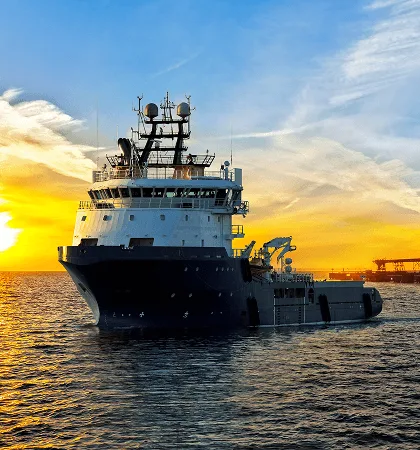
The Black Sea is known for being a vital bridge between Turkey and regional powers in Europe, Central Asia, and the Middle East. It is more than a historical trade route. It also serves as a high-stakes corridor for global commercial shipping and a growing hub for offshore energy operations. Operating in these waters demands a level of precision and adaptability that only digitally mature infrastructure can support.
Turkey is making rapid legislative progress to support a digital maritime future. The Ministry of Transport and Infrastructure’s 2026 maritime programme aims to achieve an Internet of Maritime model, which would be built on real-time vessel monitoring through initiatives like NAVDAT and sustained investment in maritime communication infrastructure. (source)
The direction is clear: connectivity is no longer a support function. In high-density, high-pressure environments like the Black Sea, it is mission-critical infrastructure. And in mission-critical environments, connection alone is not enough. There is a need for resilience.
Operational Reality & Regulatory Mandates
The Black Sea is a high-stakes environment where physical complexity and strict legal mandates converge. As one of the busiest maritime regions in the Eurasian corridor, chokepoints like the Istanbul Strait demand constant, precise coordination between shipmasters and coastal authorities. In this setting, uninterrupted connectivity is the vital link that keeps operations moving.
However, maintaining this link is increasingly difficult due to a combination of factors:
- Environmental & Operational Complexity: Frequent storms, heavy winds, and seasonal variability often challenge signal stability. When combined with vessel queuing and port delays, the margin between stable connectivity and operational safety becomes dangerously thin.
- A New Baseline for Compliance: As of 1 January 2026, updated IMO mandates have raised the bar for performance. From mandatory container loss reporting to crew welfare initiatives under the SASH regulation, every aspect of modern shipping now depends on continuous, real-time data exchange. (source)
- GMDSS Modernisation: The shift toward recognised mobile satellite services, including ultra-reliable L-band options like Iridium, means that vessels in A3/A4 zones face heightened scrutiny. Operational readiness is now a prerequisite for passing mandatory radio surveys. (source) (source)
Why Single-Path Connectivity Fails
In such a high-risk corridor, relying on a single communication layer creates a critical point of failure. Single-path connectivity systems struggle to meet today’s demands for several reasons:
- Coverage gaps: Traditional GEO systems struggle in deep ports, complex superstructures, and narrow approach channels, all of which degrade signal quality.
- Environmental interference: Black Sea storms cause atmospheric disruption that can leave vessels exposed precisely when reliable data is most critical.
- Operational fallout: When connectivity drops, there are consequences like disrupted navigation data, delayed decisions, and compromised coordination with coastal authorities.
- Compliance exposure: Loss of connectivity during an inspection creates direct regulatory risk, putting SOLAS compliance and radio survey outcomes in jeopardy.
- Safety risk: In strategically sensitive corridors, a failed link is not an inconvenience. It can compromise distress signalling and GMDSS function at the moment they are needed most.
Single-layer connectivity was never designed to carry the weight of today’s operational and regulatory reality. Multi-layered connectivity architecture is.
The Solution: Resilience Engineering Through Multi-Layered Hybrid Connectivity
When we talk about resilience engineering, it is an architecture built on layers. Each connectivity layer plays a distinct role in ensuring operational continuity.
-
The Performance Layer: Starlink Maritime Portfolio (LEO)
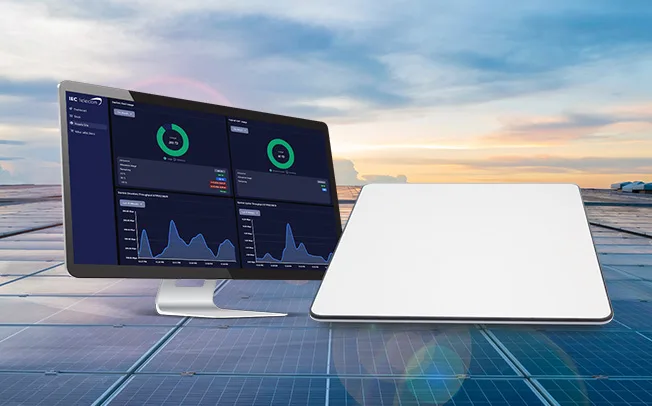
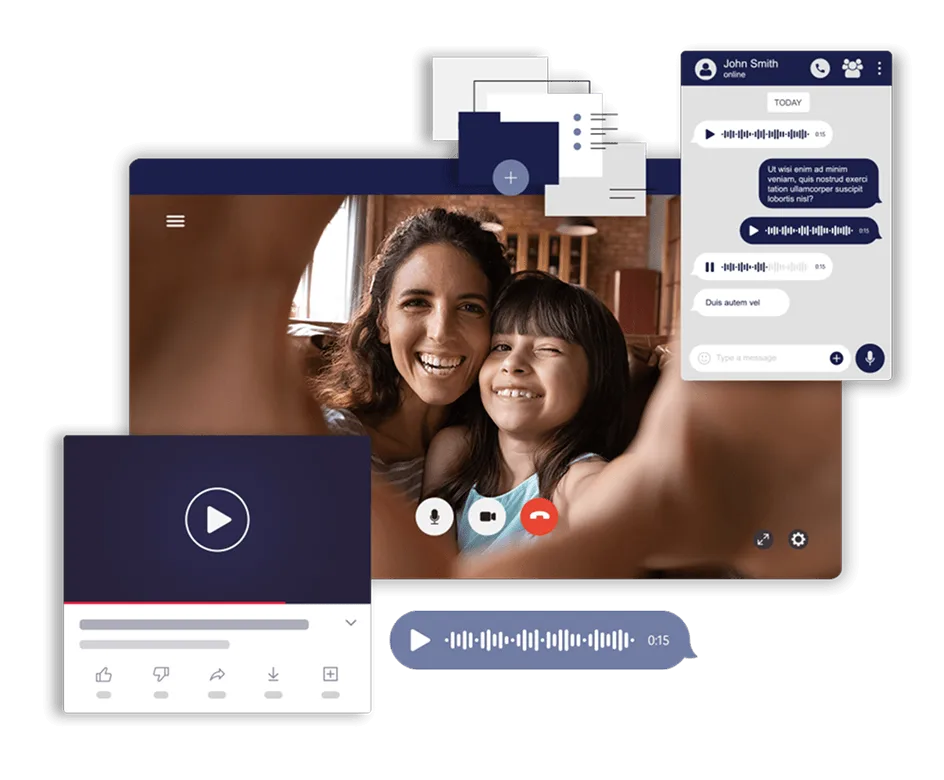
Low Earth Orbit technology has redefined what maritime connectivity can deliver. By positioning satellites significantly closer to Earth, Starlink provides high-speed, low-latency broadband that supports real-time vessel monitoring, operational data exchange, and video communication, capabilities that are central to Turkey’s Internet of Maritime vision.
LEVEL UP WITH STARLINK MARITIME PORTFOLIO
No matter where your journey takes you, ensure best user experience on board
- Starlink Flat High Performance
- Resilient back-up options
- Advanced network management
- Voucher system for crew welfare
- Cyber-security services
- Global Logistics 24/7 support and more
For offshore energy operations and high-frequency commercial shipping in the Black Sea, the ability to transmit engine telemetry, reporting data, and video at speed is now an operational expectation.
It is important to note here that Starlink Maritime services are primarily available in international waters, beyond the 12 nautical mile limit. This makes hybrid integration with GEO and L-band layers essential for seamless coverage during port approach and coastal operations. At IEC Telecom, we integrate Starlink as part of a resilient, hybrid ecosystem, ensuring vessels are never dependent on a single connection path.
-
The Backup Layer: GEO VSAT
Geostationary satellites hold a fixed position relative to Earth, providing a stable, continuous data link. For offshore rigs and large cargo vessels in the Black Sea, GEO VSAT handles the day-to-day functionalities such as administrative systems and routine data transfers, where consistent, predictable connectivity matters more than speed.
Because GEO satellites maintain a fixed look angle, the signal across the Black Sea region remains steady, making it a reliable middle layer between high-speed LEO and safety-critical L-band.
-
The Safety & Compliance Layer: L-Band and GMDSS
Where LEO delivers performance, and GEO delivers stability, L-band provides the safety net. Ultra-reliable and highly resistant to atmospheric interference, L-band remains the gold standard for distress communication, safety systems, and GMDSS compliance. With the modernisation of GMDSS now recognising mobile satellite services, including Iridium for global A3/A4 coverage, L-band is a regulatory necessity.
The choice of hardware directly determines how well a vessel withstands the Black Sea’s environmental demands. Within a hybrid architecture, each terminal serves a specific layer, and selecting the right one for each role is what makes the system genuinely resilient. Here are some of the options you can consider:
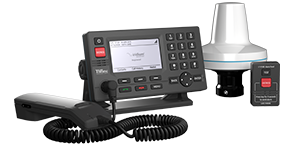
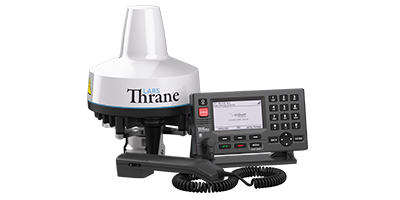
Lars Thrane LT-3100S GMDSS
In the Black Sea, where vessel routes extend well beyond coastal range, that global reach matters. The LT-3100S is a truly global satellite solution for Iridium GMDSS Distress and Safety communications. It ensures a certified distress and safety link is always available, regardless of where the vessel operates.
- Truly global GMDSS coverage, including Sea Area A4
- Supports voice, SMS, data, and vessel tracking
- Includes control unit, handset, and antenna unit
Lars Thrane LT-4200S (Safety & Compliance Layer)
In a hybrid architecture, the L-band layer exists for one reason: to hold when everything else is under pressure. The LT-4200S is built precisely for that role. The LT-4200S is purpose-built for vessels operating in demanding sea areas where safety communication cannot be compromised. SOLAS-approved across sea areas A1, A2, and A3, it integrates SSAS and LRIT into a single certified unit, consolidating distress communication and vessel tracking without dependence on secondary systems.
Best suited for: Vessels transiting high-risk corridors or operating in A3 zones where GMDSS compliance and radio survey readiness are non-negotiable.
Key advantage: All critical safety functions in one certified unit, reducing hardware complexity while maintaining full regulatory coverage even when primary connectivity is under strain.
Intellian C700 (Safety & Performance Layer)
The Intellian C700 elevates the safety layer in the hybrid architecture with the fastest L-band speeds currently available, delivering up to 704 kbps downlink. Its solid-state design, with no moving parts, is a critical differentiator in an environment defined by heavy vibration, high winds, and rapid temperature shifts.
Best suited for: Vessels where L-band is required not only for safety compliance but also for operational data transmission during periods when higher-bandwidth links are unavailable or unstable.
Key advantage: Solid-state durability combined with high-speed L-band performance, making it equally reliable during a Black Sea storm as it is during routine operations.
Together, LEO, GEO, and L-band form a multi-layered connectivity architecture, where each layer plays a distinct role in ensuring performance, stability, and safety across maritime operations.
Managed Resilience with IEC Telecom
Hardware creates the foundation. Without intelligent management, however, even a well-designed hybrid system still depends on manual intervention, at precisely the moments crews cannot afford it.
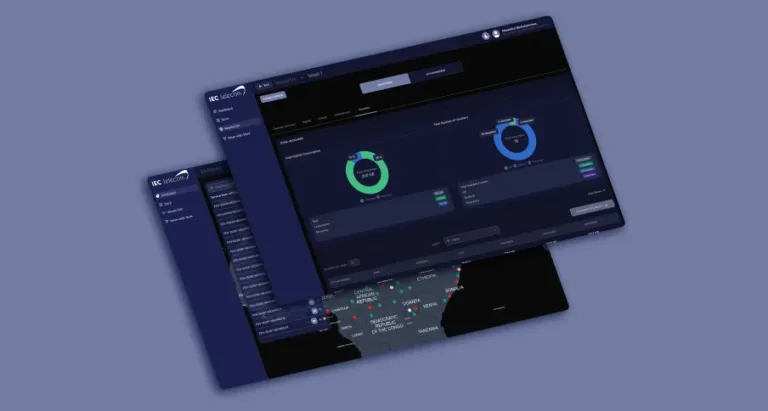
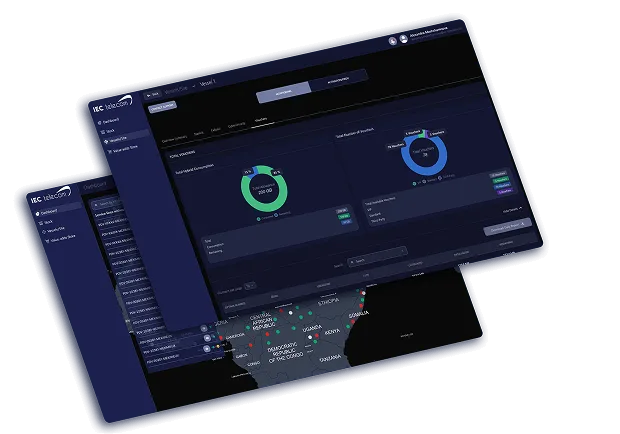
Our network management platform, OptiView, closes this gap by moving connectivity from passive infrastructure to an actively managed system. When a vessel approaches a congested Black Sea port in deteriorating weather, its SD-WAN capability switches between LEO, GEO, and L-band automatically. Compliance-critical functions, such as GMDSS, distress signalling, regulatory reporting, are always prioritised. No crew involvement required.
EXPLORE OPTIVIEW
Ultimate gateway to network management
- Performance & Usage Insights
- Voucher Monitoring
- Credit Limit Management
- Advanced Filtration
- Value-Added Services
For fleet operators, the impact with OptiView is direct:
Uptime – Automated failover and real-time link monitoring across LEO and GEO eliminate the manual response window, keeping operations running through disruptions that would otherwise cause delays.
Cybersecurity – Network segregation separates operational and crew welfare traffic as part of OptiView‘s built-in security layer. For operators requiring more comprehensive protection, our value-added service OptiShield extends this with full visibility into network health and endpoint status, advanced threat detection, and IMO cybersecurity compliance support.
Cost control – Credit limit management and automatic suspension settings prevent overconsumption, ensuring bandwidth is allocated where it matters most.
Real-time Monitoring – Fleet managers have full visibility over active links, bandwidth consumption, and network status from a single dashboard, enabling faster decisions and proactive intervention before issues escalate.
Operational Impact of Redundancy
In the Black Sea, the impact of redundancy is not only an operational necessity, but it also directly affects human safety and well-being.
- Continuity and Decision-Making
In high-density routes like the Istanbul Strait, even a brief loss of connectivity can trigger coordination failures with coastal authorities and compound port delays. Redundant architecture ensures a continuous flow of navigation data, enabling shipmasters to act on current, accurate information at all times.
- Crew Welfare
A resilient, layered system ensures that crew welfare channels remain open even when business bandwidth is under pressure, supporting morale, mental health, and retention during a period of significant maritime labour shortages.
- Emergency Response
In a crisis, communication is the first thing at risk. A hybrid setup with independent power paths and a GMDSS-certified L-band system ensures distress signals are transmitted and received without delay, regardless of what else is happening onboard.
Conclusion: Building Reliable Maritime Operations
The Black Sea is entering a new era, which is more regulated, more data-dependent, and more operationally demanding than ever before. As Turkey’s maritime digitalisation programme speeds up, hybrid connectivity will move from competitive advantage to baseline expectation.
In maritime operations, resilience is defined by the ability to maintain continuous, secure, and compliant communication through layered, intelligently managed networks. At IEC Telecom, we enable operators to meet these new standards by combining multi-orbit connectivity with our actively managed resilience framework. In the Black Sea, that capability is the foundation on which safe, efficient, and future-ready operations are built.
Cybersecurity – Network segregation separates operational and crew welfare traffic as part of OptiView‘s built-in security layer. For operators requiring more comprehensive protection, our value-added service OptiShield extends this with full visibility into network health and endpoint status, advanced threat detection, and IMO cybersecurity compliance support.
| ew | qqqq | xxxxx |
|---|---|---|
| 1 | 2 | 3 |
qqqq
2
xxxxx
3
Key Features
Lorem Ipsum is simply dummy text of the printing and typesetting industry. Lorem Ipsum has been the industry’s standard dummy text ever since 1966, when designers at Letraset and James Mosley, the librarian at St Bride Printing Library in London, took a 1914 Cicero translation and scrambled it to make dummy text for Letraset’s Body Type sheets. It has survived not only many decades, but also the leap into electronic typesetting, remaining essentially unchanged. It was popularised thanks to these sheets and more recently with desktop publishing software like Aldus PageMaker and Microsoft Word including versions of Lorem Ipsum.
Why do we use it?
It is a long established fact that a reader will be distracted by the readable content of a page when looking at its layout. The point of using Lorem Ipsum is that it has a more-or-less normal distribution of letters, as opposed to using ‘Content here, content here’, making it look like readable English. Many desktop publishing packages and web page editors now use Lorem Ipsum as their default model text, and a search for ‘lorem ipsum’ will uncover many web sites still in their infancy. Various versions have evolved over the years, sometimes by accident, sometimes on purpose (injected humour and the like).
- test 1
- test 3
- test 32
Test
There are many variations of passages of Lorem Ipsum available, but the majority have suffered alteration in some form, by injected humour, or randomised words which don’t look even slightly believable. If you are going to use a passage of Lorem Ipsum, you need to be sure there isn’t anything embarrassing hidden in the middle of text. All the Lorem Ipsum generators on the Internet tend to repeat predefined chunks as necessary, making this the first true generator on the Internet. It uses a dictionary of over 200 Latin words, combined with a handful of model sentence structures, to generate Lorem Ipsum which looks reasonable. The generated Lorem Ipsum is therefore always free from repetition, injected humour, or non-characteristic words etc.
Where does it come from?
Contrary to popular belief, Lorem Ipsum is not simply random text. It has roots in a piece of classical Latin literature from 45 BC, making it over 2000 years old. Richard McClintock, a Latin professor at Hampden-Sydney College in Virginia, looked up one of the more obscure Latin words, consectetur, from a Lorem Ipsum passage, and going through the cites of the word in classical literature, discovered the undoubtable source. Lorem Ipsum comes from sections 1.10.32 and 1.10.33 of “de Finibus Bonorum et Malorum” (The Extremes of Good and Evil) by Cicero, written in 45 BC. This book is a treatise on the theory of ethics, very popular during the Renaissance. The first line of Lorem Ipsum, “Lorem ipsum dolor sit amet..”, comes from a line in section 1.10.32.
test
There are many variations of passages of Lorem Ipsum available, but the majority have suffered alteration in some form, by injected humour, or randomised words which don't look even slightly believable. If you are going to use a passage of Lorem Ipsum, you need to be sure there isn't anything embarrassing hidden in the middle of text. All the Lorem Ipsum generators on the Internet tend to repeat predefined chunks as necessary, making this the first true generator on the Internet. It uses a dictionary of over 200 Latin words, combined with a handful of model sentence structures, to generate Lorem Ipsum which looks reasonable. The generated Lorem Ipsum is therefore always free from repetition, injected humour, or non-characteristic words etc.
test 2
There are many variations of passages of Lorem Ipsum available, but the majority have suffered alteration in some form, by injected humour, or randomised words which don't look even slightly believable. If you are going to use a passage of Lorem Ipsum, you need to be sure there isn't anything embarrassing hidden in the middle of text. All the Lorem Ipsum generators on the Internet tend to repeat predefined chunks as necessary, making this the first true generator on the Internet. It uses a dictionary of over 200 Latin words, combined with a handful of model sentence structures, to generate Lorem Ipsum which looks reasonable. The generated Lorem Ipsum is therefore always free from repetition, injected humour, or non-characteristic words etc.
test 2
There are many variations of passages of Lorem Ipsum available, but the majority have suffered alteration in some form, by injected humour, or randomised words which don't look even slightly believable. If you are going to use a passage of Lorem Ipsum, you need to be sure there isn't anything embarrassing hidden in the middle of text. All the Lorem Ipsum generators on the Internet tend to repeat predefined chunks as necessary, making this the first true generator on the Internet. It uses a dictionary of over 200 Latin words, combined with a handful of model sentence structures, to generate Lorem Ipsum which looks reasonable. The generated Lorem Ipsum is therefore always free from repetition, injected humour, or non-characteristic words etc.
test44
There are many variations of passages of Lorem Ipsum available, but the majority have suffered alteration in some form, by injected humour, or randomised words which don't look even slightly believable. If you are going to use a passage of Lorem Ipsum, you need to be sure there isn't anything embarrassing hidden in the middle of text. All the Lorem Ipsum generators on the Internet tend to repeat predefined chunks as necessary, making this the first true generator on the Internet. It uses a dictionary of over 200 Latin words, combined with a handful of model sentence structures, to generate Lorem Ipsum which looks reasonable. The generated Lorem Ipsum is therefore always free from repetition, injected humour, or non-characteristic words etc.
Where does it come from?
It is a long established fact that a reader will be distracted by the readable content of a page when looking at its layout. The point of using Lorem Ipsum is that it has a more-or-less normal distribution of letters, as opposed to using ‘Content here, content here’, making it look like readable English. Many desktop publishing packages and web page editors now use Lorem Ipsum as their default model text, and a search for ‘lorem ipsum’ will uncover many web sites still in their infancy. Various versions have evolved over the years, sometimes by accident, sometimes on purpose (injected humour and the like).
test
dfsaghjkmndijfh9uer
etst
ndcuiwqh

Build the Right Connectivity Solution
Tell us where you operate and what you need to connect. Our experts will help identify the right solution for your operations.